
[Updated January 16, 2026]
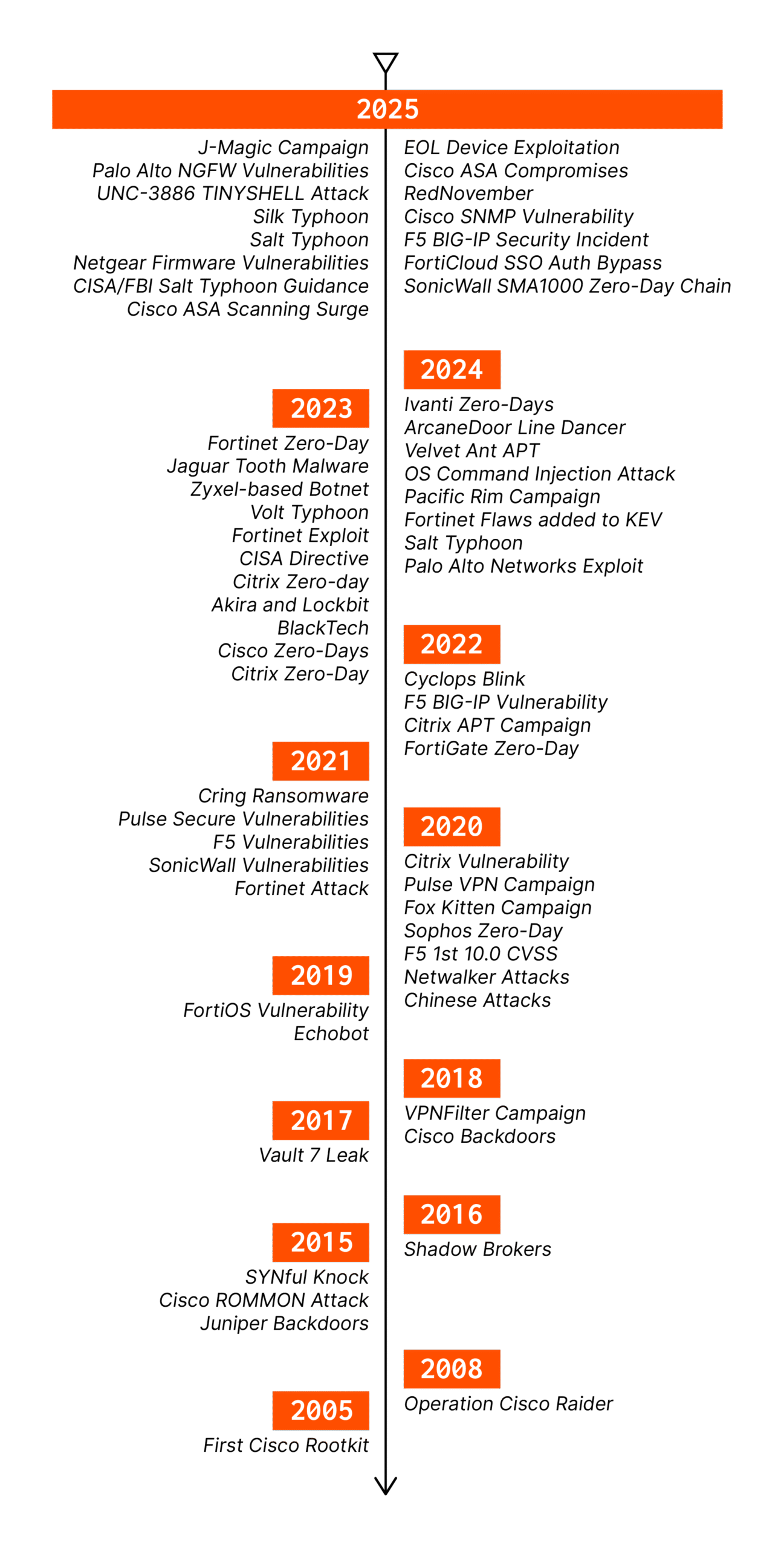
In 2025, the Verizon Data Breach Investigation Report (DBIR) reported an 8x increase in vulnerability exploitation against network edge devices such as VPNs, firewalls, load balancers, switches, and routers. They also reported a median time-to-exploitation of zero days for network vulnerabilities, and a median time to patch over 30 days. This prompted us to update our ongoing timeline of network device attacks, documenting the history of attacks against network devices since 2005. The 20 year trend of increasing attacks against the network edge shows no sign of slowing down. The infographic below is not exhaustive, but provides a visual depiction of how these attacks have grown in sophistication and scale.
Download timeline the summary here >
Targeting network devices is not restricted to nation state APTs. Ransomware gangs are also seeing great success using network vulnerabilities as initial intrusion vectors into victim organizations. In 2025, At-Bay Cyberinsurance reported that organizations with on-premises VPNs from Cisco or Citrix were 6.8x more likely to have filed a claim due to a ransomware attack.
Network devices have become a favorite initial access vector for ransomware operators because they exist in highly privileged parts of an organization and lack security tooling like EDR, while providing ample opportunity for lateral movement within the internal network and the ability to covertly route command and control traffic.
Insecure network infrastructure is causing lots of trouble
Fundamentally, the security of network infrastructure is subpar. Insecure software and inadequate vendor responses have left IT organizations scrambling to patch a seemingly endless stream of vulnerabilities. Because the patch process can affect production traffic, remediation often lags weeks or months behind the normal patching cadence seen with desktop and server operating systems. For example, in June 2023, a 9.8 CVSS remote code execution bug was patched in Fortinet devices; three weeks later, 330K devices were still vulnerable.
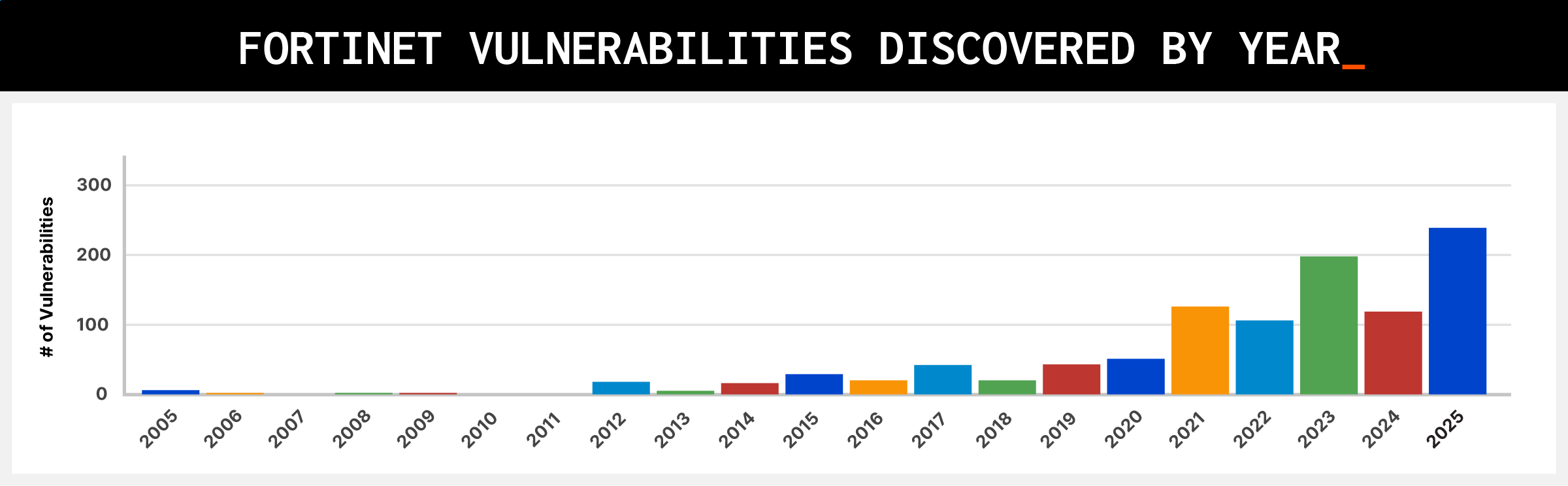
Fortinet serves as a case in point. Querying the NIST NVD database, we can see the number of vulnerabilities in Fortinet devices alone has gone up significantly in the past few years. As of this writing, there were a record 185 vulnerabilities discovered in 2023 (compared with 106 in 2022, 126 in 2021, and 51 in 2020, see chart below). Other network device vendors have seen similar increases in discovered vulnerabilities.
Then, in December 2025, Fortinet patched a vulnerability that was being actively exploited, only to learn within weeks that the patch had failed, and customers who had installed the patch were still being compromised with the same vulnerabilities.
When patches take weeks, and sometimes fail, leading to yet another cycle of patching for the same threats, it becomes clear that a new approach is needed to secure the network edge.
To lessen their exposure to these product vulnerabilities, organizations need to start incorporating product security evaluations into their vendor risk assessment processes. Similar to how the National Highway Traffic Safety Administration provides crash test ratings for passenger vehicles, Eclypsium provides third-party insight into the safety of IT products such as network devices. In addition, Eclypsium adds layered defenses to these devices in production, helping with vulnerability management and detection of compromise.
Additional Resources
Product tour: Eclypsium Guide to Supply Chain Security
White paper: Network Infrastructure on the Front Line
Webinar: Network Infrastructure in Ransomware’s Crosshairs
Blog: A New Approach to Defending Network Infrastructure

2025
January

J-Magic Campaign targets carrier-grade Juniper routers with a custom backdoor based on the open-source cd00r tool. Discovered by Black Lotus Labs, the campaign involved attackers configuring the malware to listen for incoming “Magic Packets” on the network, then establishing reverse shells for persistent access. The attacks primarily targeted telecommunications carriers and internet service providers running enterprise-grade network infrastructure. [49] Nation-state
Palo Alto Networks NGFW Vulnerabilities are disclosed by Eclypsium researchers who discovered multiple security issues in three firewall appliances: PA-3260, PA-1410, and PA-415. The findings include bootloader vulnerabilities (BootHole), InsydeH20 UEFI flaws, and security misconfigurations. Researchers warn that attackers could chain exploits to bypass Secure Boot and install persistent malware in the boot process. [50] Nation-state
March
UNC-3886 TINYSHELL Attack involves Chinese APT group UNC-3886 deploying custom TINYSHELL-based backdoors on Juniper MX-series routers. Mandiant identified at least six malware variants designed to evade detection on devices lacking traditional security monitoring. The attackers bypassed Juniper’s veriexec protection through process memory injection, now tracked as CVE-2025-21590, targeting telecommunications carriers and ISPs. [51] Nation-state
Silk Typhoon Targets IT Supply Chain by exploiting CVE-2025-0282, a remotely exploitable stack-based buffer overflow in Ivanti Connect Secure, Policy Secure, and ZTA Gateways. Microsoft Threat Intelligence reports the Chinese espionage group is targeting common IT infrastructure providers including Ivanti, Citrix, Palo Alto, and Microsoft itself, using supply chain attacks for broad access to downstream targets. [52] Nation-state
June

Salt Typhoon Breaches Canadian Telcos and Viasat by exploiting CVE-2023-20198, a critical Cisco IOS XE vulnerability. The Chinese APT created administrative accounts and configured GRE tunnels for persistent access and data collection. The Viasat breach marks a significant escalation beyond traditional terrestrial telecom targets, demonstrating that this 18-month-old flaw remains a primary attack vector against satellite communications infrastructure. [53] Nation-state
July
Netgear Firmware Vulnerabilities in Enterprise IoT Devices pose significant risks as eight CVEs affecting Netgear products have been added to the CISA KEV catalog, confirming active exploitation. Chinese APT groups like Volt Typhoon have been observed compromising SOHO routers, including Netgear models, to establish proxy infrastructure for stealthy attacks on critical infrastructure. With over 500 security advisories released by Netgear, these devices remain attractive targets due to their dual connectivity bridging internal networks to the internet, lack of monitoring, and complex firmware supply chains. [54] Nation-state/IoT
August
CISA/FBI Release Salt Typhoon Defense Guidance in Cybersecurity Advisory AA25-239A, detailing specific CVEs in Cisco and Palo Alto equipment being targeted by Chinese APTs. The guidance includes specific recommendations for protecting firmware from attacks and represents an enormous step forward in attribution, providing defenders with detailed TTPs for defending against PRC-sponsored threat groups targeting network infrastructure. [55] Nation-state
Cisco ASA Scanning Surge observed by GreyNoise shows over 25,000 unique IPs probing Cisco Adaptive Security Appliance login portals in a single burst, far exceeding the normal baseline of fewer than 500 per day. The anomalous activity suggests coordinated reconnaissance ahead of potential vulnerability exploitation. With over 113,000 ASA devices exposed to the public internet, the risk to organizations is dramatically amplified. [56] Reconnaissance
September
EOL Device Exploitation Campaigns target end-of-life network devices including Cisco Small Business RV routers, Linksys LRT series, and Araknis Networks equipment. The FBI warns that Russian government spies exploited a seven-year-old bug in end-of-life Cisco devices to access American critical infrastructure networks. Attackers continue using techniques ranging from latest zero-days to exploits that are 15 years or older. [57] Nation-state
CISA ED 25-03: Cisco ASA Compromises lead to mandates that federal agencies patch CVE-2025-20333 (remote code execution) and CVE-2025-20362 (privilege escalation) in Cisco ASA devices by October 2nd. The emergency directive is linked to ongoing ArcaneDoor campaign activity. Attackers have demonstrated capability to modify ASA ROM for persistence through reboots and system upgrades, requiring urgent forensic triage and patching. [58] Nation-state

RedNovember Attack Campaign disclosed by Recorded Future’s Insikt Group exploits network edge devices including SonicWall, Cisco, Palo Alto, Fortinet, and Ivanti equipment to breach government and defense organizations. The campaign demonstrates increased targeting of VPNs, firewalls, load balancers, and virtualization infrastructure. Attackers combine weaponized proof-of-concept exploits with open-source post-exploitation frameworks, lowering barriers for less-capable threat actors. [59] Nation-state
October
Cisco SNMP Vulnerability CVE-2025-20352 is actively exploited in the wild, affecting up to 2 million Cisco IOS and IOS XE devices globally. Added to CISA KEV on September 29th, this stack overflow vulnerability in the SNMP subsystem enables authenticated remote attackers to trigger denial-of-service or execute code as root. The exploitation pattern mirrors tactics of APT groups like Volt Typhoon and Velvet Ant. [60] Nation-state

F5 BIG-IP Security Incident disclosed after nation-state actors (reportedly China-linked UNC5221) maintained persistent access to F5’s development network. Attackers exfiltrated source code and details on 44 undisclosed vulnerabilities. CISA issued Emergency Directive 26-01 mandating federal agencies inventory and patch all BIG-IP systems. The breach highlights growing risk of supply chain compromises targeting network infrastructure vendors. [61] Nation-state
December
Fortinet FortiCloud SSO Authentication Bypass (CVE-2025-59718 & CVE-2025-59719) allows unauthenticated attackers to bypass FortiCloud SSO login authentication using crafted SAML messages. With a critical CVSS score of 9.1, the flaws affect multiple Fortinet products where FortiCloud SSO is enabled. Arctic Wolf observed malicious activity shortly after disclosure, with attackers stealing system configuration files containing sensitive network topology and credential material. CISA added CVE-2025-59718 to the KEV catalog. [62] Nation-state
SonicWall SMA1000 Zero-Day Chain (CVE-2025-40602 + CVE-2025-23006) demonstrates how attackers combine vulnerabilities for maximum impact. The medium-severity local privilege escalation flaw CVE-2025-40602 is being chained with CVE-2025-23006, a pre-auth deserialization bug, to achieve unauthenticated remote code execution with root privileges. CISA added CVE-2025-40602 to the KEV catalog based on active exploitation in the wild. [63] Nation-state
2024
January

Ivanti discloses two zero-day vulnerabilities in its Connect Secure (formerly Pulse Secure) VPN product observed to be exploited by a Chinese nation-state attacker since December. Mass exploitation begins soon after proof-of-concept code is published, while no patch is available for weeks. [42] CISA issues an emergency directive ordering federal civilian agencies to mitigate the vulnerabilities with configuration changes and an integrity checker tool. [43] Nation-state
April
ArcaneDoor Line Dancer is a memory-resident shellcode interpreter discovered on compromised Cisco Adaptive Security Appliance (ASA) devices. This implant allows attackers to upload and execute arbitrary shellcode payloads via the host-scan-reply field of WebVPN HTTP(S) POST requests, enabling unauthorized command execution without leaving traces on the disk. [44] Nation-state
June

Velvet Ant APT is a sophisticated China-nexus threat actor known for prolonged cyber-espionage campaigns. In a notable incident, they maintained access to a large organization’s on-premises network for approximately three years, exploiting vulnerabilities in legacy systems like F5 BIG-IP appliances to establish multiple footholds and evade detection. [45] Nation-state
July
The Cybersecurity and Infrastructure Security Agency (CISA) issued an alert regarding vulnerabilities in network devices susceptible to OS command injection attacks. Exploiting these flaws allows attackers to execute arbitrary commands on the underlying operating system, potentially leading to unauthorized access, data exfiltration, and disruption of services. [46] Nation-state
October

Sophos identified a cyber-espionage campaign dubbed “Pacific Rim,” targeting organizations in the Asia-Pacific region. Attackers employed custom malware to compromise network devices, including routers and firewalls, to establish persistent access and exfiltrate sensitive information. The campaign underscores the importance of securing network infrastructure against advanced persistent threats. [47] Nation-state
CISA added a critical security flaw impacting Fortinet products to its KEV catalog, citing evidence of active exploitation. The high severity vulnerability, tracked as CVE-2024-23113, relates to a case of remote code execution that affects FortiOS, FortiPAM, FortiProxy, and FortiWeb.
November
Salt Typhoon is a Chinese state-sponsored cyber threat group that has targeted critical infrastructure, particularly in the telecommunications sector. The group exploited vulnerabilities in Cisco networking equipment, such as core routers and other infrastructure devices integral to Internet Service Providers (ISPs). These devices were leveraged to infiltrate and maintain persistent access to networks, enabling unauthorized monitoring and potential data exfiltration. [48] Nation-state
Attackers exploit a critical missing authentication vulnerability in Palo Alto Networks Expedition, a migration tool that can help convert firewall configuration from other vendors to PAN-OS. This security flaw (CVE-2024-5910) can be remotely exploited to reset application admin credentials on Internet-exposed Expedition servers.
2023
March
Another Fortinet zero-day is discovered (CVE-2022-41328) being exploited by Chinese hackers (UNC3886), who use the appliances as a pivot to ESXi infrastructure and then to VM guests. [32] Nation-state
April

The U.K. National Cyber Security Centre releases a report warning of Jaguar Tooth malware targeting Cisco IOS. Nation-state
May
Security researchers observe widespread exploitation of CVE-2023-28771 in Zyxel devices to build a Mirai-based botnet. [33] Nation-state

22 Danish energy firms are compromised in a campaign that exploited CVE-2023-28771 as well as two new zero-day vulnerabilities in Zyxel devices (CVE-2023-33009 and CVE-2023-33010). The attacks were attributed to the Russian Sandworm group. [34] Nation-state

Microsoft publishes details of its investigation into the Chinese Volt Typhoon group targeting U.S. critical infrastructure. The attackers use an unknown Fortinet exploit and use routers from ASUS, Cisco, D-Link, NETGEAR, and Zyxel as proxies for C2 traffic. [35] Nation-state
In response to an ongoing campaign utilizing a zero-day vulnerability (CVE-2023-2868) against Barracuda appliances, the vendor recommends that customers return their appliances for new ones. [36] Nation-state
June

CISA directs federal agencies to either implement zero-trust for network management interfaces or remove them from the internet. [37]
July

CVE-2023-3519 is discovered as a zero-day in Citrix Netscalers and mass exploitation commences within weeks, compromising 30K+ devices. The campaign is attributed to the ransomware actor FIN8. [38] Ransomware
August

Rapid7 responds to a number of incidents involving Cisco ASA SSL VPNs, some involving ransomware gangs Akira and Lockbit. Less than two weeks later, Cisco discloses CVE-2023-20269 which is related. Ransomware
September
The NSA and the Japanese government issue a warning about the Chinese group BlackTech targeting “various brands and versions” of routers to install implants for espionage. [39] Nation-state
October
Cisco discovers a campaign exploiting two zero-day vulnerabilities (CVE-2023-20198 and CVE-2023-20273) to create admin accounts and install implants on Cisco IOS XE devices. Before a patch is available, at least 10K devices are infected. [40]

A zero-day vulnerability (CVE-2023-4966) dubbed Citrix Bleed is discovered. Mandiant reports threat activity since August, allowing attackers to hijack authenticated sessions. [41] Lockbit and ALPHV/BlackCat use Citrix Bleed to compromise numerous organizations, including Boeing, ICBC, Toyota Financial Services, DP World, and Fidelity National Financial. Ransomware
2022
Cyclops Blink malware targets Watchguard firewalls and ASUS routers, and is attributed to the Russian Sandworm threat group. In a court-authorized operation, the FBI disabled the botnet by removing the malware and closing external management ports on infected devices used for C2. [28] Nation-state

CVE-2022-1388 affects F5 BIG-IP devices and is listed among CISA Top 12 Routinely Exploited Vulnerabilities for 2022. [29]
The NSA releases threat hunting guidance for Citrix ADC devices targeted by APT5 as part of its espionage activities. Recommendations include checking hashes of important binaries, monitoring logs, and running YARA rules to look for specific malware used. [30] Nation-state
A critical zero-day vulnerability (CVE-2022-42475) is discovered in FortiGate firewalls during an incident investigation by the vendor. [31]
2021

Kaspersky details techniques used by attackers to install Cring ransomware in enterprise victims. Initial access focused on vulnerable FortiGate VPN appliances. [21] Ransomware
Multiple campaigns target vulnerabilities in Pulse Secure VPN appliances, including a zero-day (CVE-2021-22893). Mandiant tracks 12 separate malware families targeting Pulse Secure devices and also says Chinese state-sponsored groups exploit these vulnerabilities for espionage. [22][23] Nation-state

F5 publishes a security advisory containing 21 CVEs, including four critical vulnerabilities. CVE-2021-22986 is later observed as an initial access vector for Lockbit 3.0. [24] Ransomware

Dozens of critical vulnerabilities involving SQL injection, buffer overflow, out-of-bound read, etc. are discovered in SonicWall devices. Mandiant notes the ransomware group UNC2447 uses some of these exploits for initial access and persistence. [25][26] Ransomware

Hackers publish a list of credentials stolen from 87K Fortinet devices on a ransomware forum. The credentials were harvested using a vulnerability from 2018. [27] Ransomware
2020

Security researchers detail a campaign targeting Citrix ADCs as entry points to disable Windows Defender and install Ragnarok ransomware on Windows machines in the network. [13] Ransomware

Criminals launch a wide-scale campaign targeting Pulse Secure VPN appliances to steal Active Directory credentials, disable endpoint security, and install REvil ransomware. [14] Ransomware
Security researchers detail the techniques of the Iranian-backed Fox Kitten campaign, whose primary method of initial access is VPN devices from Citrix, Fortinet, Palo Alto Networks, and Pulse Secure. [15] Nation-state

COVID-19 restrictions in March put a focus on the security and availability of VPN infrastructure as employees connect remotely. [16]

Sophos alerts customers to a zero-day exploit against its XG firewalls that deploys the Asnarök data-stealing trojan and then attempts to install Ragnarok ransomware. The attacks are foiled by a hotfix from the vendor. [17] Ransomware
F5 discloses its first-ever vulnerability with a CVSS of 10.0. Public exploits are available within a week and the vulnerability is widely exploited. [18]

The FBI releases IOCs for widespread Netwalker ransomware attacks that target vulnerable Pulse Secure VPN devices for initial access. [19] Ransomware
CISA issues a cybersecurity advisory to help U.S. government agencies defend against Chinese state-sponsored attack activity, which includes exploiting recent vulnerabilities in F5 BIG-IP, Citrix VPN, and Pulse Secure VPN appliances. [20] Nation-state
2019
CVE-2018-13379 is discovered in the FortiOS SSL VPN web portal. This vulnerability is subsequently listed among CISA’s Top 12 Routinely Exploited Vulnerabilities in 2020, 2021, and 2022, underscoring the difficulty in patching network appliances. [11]
Echobot, a variant of the Mirai botnet malware, targets SCADA systems and enterprise networking gear, including Barracuda and Citrix appliances. [12]
2018
The VPNFilter campaign infects 500K+ devices worldwide from Linksys, MikroTik, Netgear, and TP-Link. The malware has data collection and destructive capabilities, and is attributed to the Russian Sandworm threat group. [9] Nation-state
Five backdoors discovered in Cisco products raise worries about a supply chain attack. One of the backdoors is an undocumented user account with privilege level 15 that has a default username and password in Cisco IOS. [10]
2017

Wikileaks’ Vault 7 leak exposes tools used by the CIA and leads to the discovery of CVE-2017-3881 affecting 300+ Cisco routers and switches. [8] Nation-state
2016
The Shadow Brokers release hacking tools from the Equation Group, thought to be the NSA. The tools contain zero-day exploits of Cisco, Fortinet, and Juniper firewalls. [7] Nation-state
2015
SYNful Knock malware targets Cisco IOS devices, installing an implant that provides persistent access that is difficult to detect. [4] Nation-state
Cisco warns customers about attacks that swap ROMMON remote management firmware with maliciously altered images. [5]

Juniper discloses a supply chain attack where two backdoors were implanted in its NetScreen VPN products. Researchers attribute the backdoors to the NSA. [6] Nation-state
2008
The FBI concludes Operation Cisco Raider, a two-year initiative to disrupt a Cisco distribution network that had sold counterfeit Cisco gear to the U.S. military and other organizations. [3]
2005

Independent security researcher Mike Lynn demonstrates the first-ever Cisco IOS rootkit at the Black Hat conference. [1][2]

- The Holy Grail: Cisco IOS Shellcode And Exploitation Techniques, Michael Lynn, July 2008
- An Insider’s View of ‘Cisco-gate’, WIRED, August 2005
- FBI probe discovers counterfeit kit in US military networks, The Register, May 2008
- SYNful Knock
- Attackers are hijacking critical networking gear from Cisco, company warns, Ars Technica, August 2015
- Researchers Solve Juniper Backdoor Mystery; Signs Point to NSA, WIRED, December 2015
- Equation Group exploit hits newer Cisco ASA, Juniper Netscreen, The Register, August 2016
- The Wikileaks Vault 7 Leak – What We Know So Far, Cisco Blogs, March 2017
- VPNFilter
- Backdoors Keep Appearing In Cisco’s Routers, Tom’s Hardware, July 2018
- 2022 Top Routinely Exploited Vulnerabilities, CISA, August 2023
- Echobot Malware Now up to 71 Exploits, Targeting SCADA, F5 Labs, December 2019
- Ragnarok Ransomware Targets Citrix ADC, Disables Windows Defender, Bleeping Computer, January 2020
- VPN warning: REvil ransomware targets unpatched Pulse Secure VPN servers, ZDNet, January 2020
- Fox Kitten Campaign Widespread Iranian Espionage-Offensive Campaign, Clearsky Cybersecurity, February 2020
- Cybersecurity Advisory: Enterprise VPN Security, CISA, April 2020
- Hackers tried to use Sophos Firewall zero-day to deploy Ransomware, Bleeping Computer, May 2020
- Threat Actor Exploitation of F5 BIG-IP CVE-2020-5902, CISA, July 2020
- FBI Flash: Indicators Associated with Netwalker Ransomware, FBI, July 2020
- Chinese Ministry of State Security-Affiliated Cyber Threat Actor Activity, CISA, December 2020
- Vulnerability in FortiGate VPN servers is exploited in Cring ransomware attacks, Kaspersky, April 2021
- Check Your Pulse: Suspected APT Actors Leverage Authentication Bypass Techniques and Pulse Secure Zero-Day, Mandiant, April 2021
- Re-Checking Your Pulse: Updates on Chinese APT Actors Compromising Pulse Secure VPN Devices, Mandiant, May 2021
- LockBit: Access, Encryption, Exfiltration, & Mitigation, November 2023
- UNC2447 SOMBRAT and FIVEHANDS Ransomware: A Sophisticated Financial Threat, Mandiant, April 2021
- SonicWall Zero-Day Exploited by Ransomware Group Before It Was Patched, SecurityWeek, April 2021
- Fortinet warns customers after hackers leak passwords for 87,000 VPNs, The Record, September 2021
- Justice Department Announces Court-Authorized Disruption of Botnet Controlled by the Russian Federation’s Main Intelligence Directorate (GRU), U.S. Department of Justice, April 2022.
- 2022 Top Routinely Exploited Vulnerabilities, CISA, August 2023
- APT5: Citrix ADC Threat Hunting Guidance, NSA, December 2022
- We’re Out of Titles for VPN Vulns—It’s Not Funny Anymore, WatchTowr, January 2023
- Fortinet Zero-Day and Custom Malware Used by Suspected Chinese Actor in Espionage Operation, Mandiant, March 2023
- Hackers exploit critical Zyxel firewall flaw in ongoing attacks, BleepingComputer, May 2023
- Russian Hackers Linked to ‘Largest Ever Cyber Attack’ on Danish Critical Infrastructure, The Hacker News, November 2023
- Volt Typhoon targets US critical infrastructure with living-off-the-land techniques, Microsoft, May 2023
- Barracuda ESG Zero-Day Vulnerability (CVE-2023-2868) Exploited Globally by Aggressive and Skilled Actor, Suspected Links to China, Mandiant, June 2023
- BOD 23-02: Mitigating the Risk from Internet-Exposed Management Interfaces, CISA, June 2023
- Attacks on Citrix NetScaler systems linked to ransomware actor, BleepingComputer, July 2023
- People’s Republic of China-Linked Cyber Actors Hide in Router Firmware, NSA, September 2023
- “Cisco buried the lede.” >10,000 network devices backdoored through unpatched 0-day, ArsTechnica, October 2023
- Remediation for Citrix NetScaler ADC and Gateway Vulnerability (CVE-2023-4966), Mandiant, October 2023
- Ivanti Connect Secure VPN Exploitation Goes Global, Volexity, January 2024
- ED 24-01: Mitigate Ivanti Connect Secure and Ivanti Policy Secure Vulnerabilities, CISA, January 2024
- ArcaneDoor – New espionage-focused campaign found targeting perimeter network devices, Cisco Talos, April 2024
- China-Linked Hackers Infiltrate East Asian Firm for 3 Years Using F5 Devices, Hacker News, June 2024
- CISA, FBI Warn of OS Command-Injection Vulnerabilities, Dark Reading, July 2024
- Sophos reveals 5-year battle with Chinese hackers attacking network devices, Bleeping Computer, October 2024
- Chinese Salt Typhoon Hacked T-Mobile in US Telecom Breach Spree, Hack Read, November 2024
- Juniper Routers, Network Devices Targeted with Custom Backdoors, Eclypsium, March 2025
- Eclypsium finds security issues in Palo Alto Networks NGFWs, TechTarget, January 2025
- Juniper Routers, Network Devices Targeted with Custom Backdoors, Eclypsium, March 2025
- Silk Typhoon Targeting IT Supply Chains and Network Devices, Microsoft Reports, March, 2025
- The Cisco Vulnerability Salt Typhoon Weaponized Against Canadian Telcos and Viasat, Eclypsium, June 2025
- Vulnerabilities in Netgear Firmware-Based IoT Devices In The Enterprise, Eclypsium, July 2025
- New Salt Typhoon Defense Guidance from FBI and CISA, Eclypsium, August 2025
- Surge in Cisco ASA Scanning Hints At Coming Cyberattacks, Eclypsium, September 2025
- EOL Devices: Exploits Will Continue Until Security Improves, September 2025
- CISA ED 25-03 Warns of Cisco ASA Device Compromises, Eclypsium, September 2025
- The Hunt for RedNovember: A Depth Charge Against Network Edge Devices, Eclypsium, September 2025
- Cisco SNMP Vulnerability CVE-2025-20352 Exploited in the Wild, Eclypsium, October 2025
- F5 Systems Compromised, BIG IP Vulnerabilities Exfiltrated: What To Do Next, Eclypsium, October 2025
- 2025: The Year of Network Device Exploitation Adds Three More, Eclypsium, December 2025
- 2025: The Year of Network Device Exploitation Adds Three More, Eclypsium, December 2025