
Security teams are scrambling to reprioritize their security plans based on the revelation of Anthropic’s Mythos model, and its ability to rapidly discover security vulnerabilities. Those who make good choices during this scramble are setting themselves up to benefit massively from AI innovation. Those who ignore the gaps in Mythos’ capabilities are going to have a harder time.
During the short window when companies like Apple, Cisco, Mozilla, Palo Alto Networks, and other global tech companies had Mythos access under Project Glasswing, each found hundreds of vulnerabilities in their own code. Mozilla fixed 271 Mythos-discovered security flaws in Firefox 150 alone, some of which had been sitting in the codebase for as long as twenty years.
The optimistic case
It would be easy to dismiss all of this as vendor hype, so it’s worth being fair about what Mythos actually delivered. The Glasswing partners got a genuine head start. Mozilla reported that the findings came with “almost no false positives”, a sharp break from the years of AI-generated noise that buried earlier tools. When Anthropic and several independent security firms went back and checked the broader haul, more than 90% of the assessed high- and critical-severity findings were validated as real. Fixing flaws in foundational software like browsers and operating systems reduces risk for the billions of people who depend on that software downstream, so the work has clear value.
But there’s a detail in Mozilla’s own writeup that points to the catch. Mythos could find the bugs and even write proof-of-concept test cases to prove they were real, but it could not produce deployable fixes. Every one of those 271 patches was written and reviewed by a human engineer. That is the seam this whole story runs along. Discovery got faster. Fixing did not.
Discovery is not the same as safety
Just because a vulnerability has been discovered and patched does not mean that the world is now secure against its exploitation. Often it means the opposite. When a vulnerability is disclosed, the bad guys find out about it too. Even if a patch is issued, it takes time for that patch to be deployed to protect end users, and cyberattackers are faster than ever at exploiting both known and unknown vulnerabilities. These facts change the calculus about how Mythos will actually impact the security of enterprises, and what security teams should do to adapt to the Mythos-powered cyber future.
Patching is slowing down
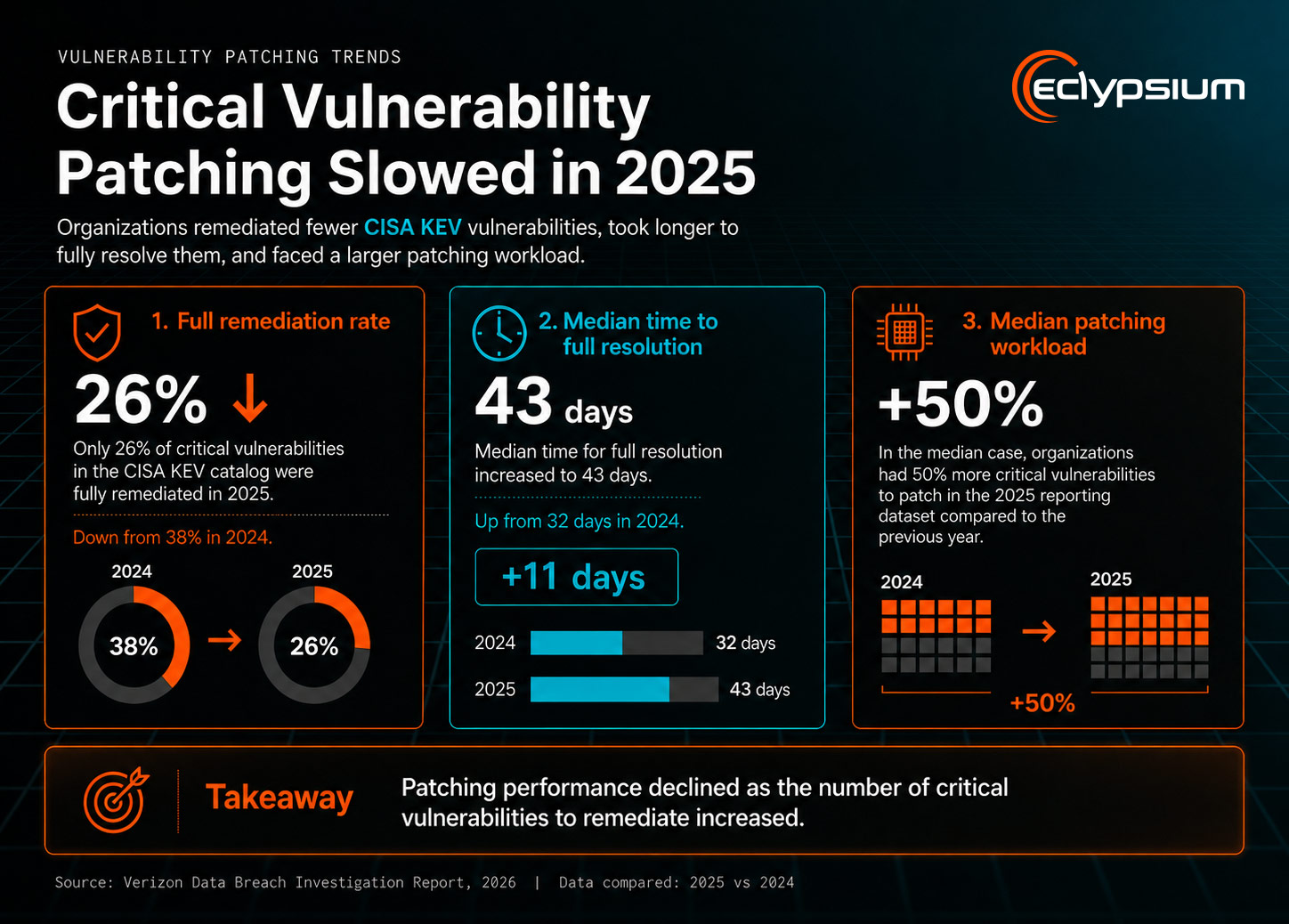
The 2026 Verizon Data Breach Investigations Report puts hard numbers on the trend. For the first time, exploitation of vulnerabilities is the leading initial access vector for breaches, accounting for 31% of them, up from roughly 20% a year earlier. At the same time, remediation got slower. The median time to fully patch a vulnerability rose from 32 days to 43 days. Only 26% of the critical vulnerabilities in CISA’s Known Exploited Vulnerabilities catalog were fully remediated, down from 38% the year before. So defenders are patching a smaller share of the flaws that attackers are actively using, and taking longer to do it, right as a new tool is about to multiply the number of flaws on the list.
The capability will not stay contained to fifty vetted partners
There’s a comforting version of this story where Mythos is a locked-down research tool, available only to about fifty hand-picked organizations under Anthropic’s supervision. That version is already out of date. Within roughly five weeks of the Mythos announcement, OpenAI launched its own security initiative, Daybreak, and Microsoft revealed MDASH. AI-driven vulnerability discovery is now an industry capability. Microsoft indicated they are on track to break their all time record for patches issued on Patch Tuesday, thanks to AI-driven vulnerability discovery.
It is also getting cheaper to reproduce. Independent research from AISLE showed that even a 3.6-billion-parameter model, wrapped in the right scaffolding, could rediscover many of the same flagship vulnerabilities Mythos showcased.
That matters for the disclosure problem. The risk is not only that a patched bug tips off attackers who read the advisory. It’s that the discovery capability itself is becoming portable enough that motivated attackers can run their own version against the same software the defenders are racing to fix.
A wave of disclosures is coming on a known schedule
The reason the public hasn’t seen the full list of Mythos findings yet is that responsible disclosure takes time. The industry convention is to hold a new vulnerability private for around 90 days, or roughly 45 days after a patch ships, so end users can update before details go public. Public disclosure of the Mythos-found vulnerabilities is expected to begin in July. In practice that means a scheduled surge of new CVEs against widely deployed software, arriving on a timeline attackers can plan around just as easily as defenders can. The window to get patching pipelines and asset inventories in order is the period before that wave lands, not after.
The bottleneck is the people who maintain the code
Anthropic has been candid that the constraint has shifted. Progress in software security used to be limited by how fast you could find bugs. Now it is limited by how fast you can verify, disclose, and patch the volume the AI surfaces, and the open-source maintainers who own much of the world’s foundational code have become a major bottleneck in that process. Many of the components Mythos has been finding flaws in are maintained by tiny teams or single volunteers. A 27-year-old denial-of-service bug in OpenBSD and a 16-year-old flaw in FFmpeg both survived that long in projects that are widely used and thinly funded. For software that ships inside other products, a fix that depends on an overloaded maintainer can take a long time to arrive, if it arrives at all.
The Network Device Visibility Gap
Network devices specifically create a huge challenge for the narrative that Mythos vulnerability discovery is good for defenders.
Network devices like firewalls, VPNs, load balancers, switches, and routers have been increasingly targeted by cyberattackers. The Verizon data reflects this directly: the 2026 DBIR report created a dedicated “Network” asset category for remote access devices, and that category jumped from 1.5% to 5% of breaches in a single year, with VPNs and remote access infrastructure among the most commonly exploited assets. The report also found that seven days after a known-exploited vulnerability is identified, somewhere between 60% and 70% of them are still open, regardless of how mature or well-resourced the organization is.
These device types are appealing to attackers for several reasons:
- Network devices often must sit at the network edge or perimeter of the network, exposed to the internet in order to perform their normal functions.
- Network devices are often broadly connected to critical resources inside enterprises and governments.
- Network devices are difficult to monitor using standard security tools. You can’t install an EDR agent on a firewall appliance.
- Network devices often run Linux or FreeBSD as their underlying operating system, with some vendor-specific version or interface on top of it. The security team at the enterprise that deploys the firewall, VPN, or load balancer probably doesn’t have access to the underlying Linux or FreeBSD OS, where many vulnerabilities are hidden. Cyberattackers will gladly reach this deeply into the system to exploit vulnerabilities, but defenders can’t go there without violating their terms of service.
The flaws Mythos found live in exactly this layer
This is not a hypothetical concern about where the bugs might be. Look at what Mythos actually surfaced. It found a remote code execution vulnerability in FreeBSD’s NFS implementation, assigned CVE-2026-4747. It found privilege-escalation chains in the Linux kernel. It found the decades-old OpenBSD and FFmpeg bugs mentioned above. It found a flaw in wolfSSL, an open-source cryptography library embedded in billions of devices, and built an exploit that would let an attacker forge certificates and impersonate a trusted site like a bank or email provider.
Those are not application-layer bugs in software an enterprise wrote and controls. They are flaws in the operating systems, network stacks, and crypto libraries that ship inside the appliances sitting at the network edge, which is exactly the kind of embedded third-party component that turns a single firewall flaw into a supply chain problem. This is the firmware and below-the-OS layer that the enterprise deploying the device usually cannot see into, cannot install an agent on, and is contractually barred from inspecting. It is also precisely the layer Mythos is good at picking apart. Protecting it is the heart of hardware and firmware supply chain security.
For these devices, “patch fast enough” isn’t even the right question
For most internal applications, an enterprise that learns about a flaw can go fix it. For a network appliance, it usually can’t. As we’ve written about firewalls specifically, the customer who owns the risk does not own the fix. They have to wait for the vendor to validate the issue, build a firmware update, and release it, and only then can the customer schedule the disruptive work of taking a perimeter device offline to apply it. The customer’s patch velocity is capped by the slowest vendor in their stack, and combined with the maintainer bottleneck on the open-source components inside that firmware, the fix can be weeks or months away even when everyone is acting in good faith.
That changes what defenders can actually do about Mythos-class discovery at the device layer. Patching faster is necessary, but it is not sufficient and it is not fully in the customer’s hands. The levers that are in the customer’s hands are knowing exactly which devices they have and what’s running on them, reducing what’s exposed to the internet, segmenting devices away from critical resources to limit blast radius, and monitoring the integrity of the devices themselves so that an exploit in that invisible layer doesn’t stay invisible.
What security teams should do now
The shift Mythos represents is not going to wait for patch cycles to catch up. Vulnerability discovery is becoming abundant while the capacity to verify, fix, and deploy stays scarce, and the gap is widest exactly where defenders have the least reach: the network and edge devices running vendor firmware on top of open-source components nobody at the enterprise can touch. The teams that come out of this scramble ahead will be the ones that stop treating the device layer as a black box and start building real visibility into it before July’s disclosures, and the attackers reproducing the same techniques, arrive.
Ready to defend the foundation of your network edge? Get our white paper: Eradicate Hidden Risks in Network Edge Devices